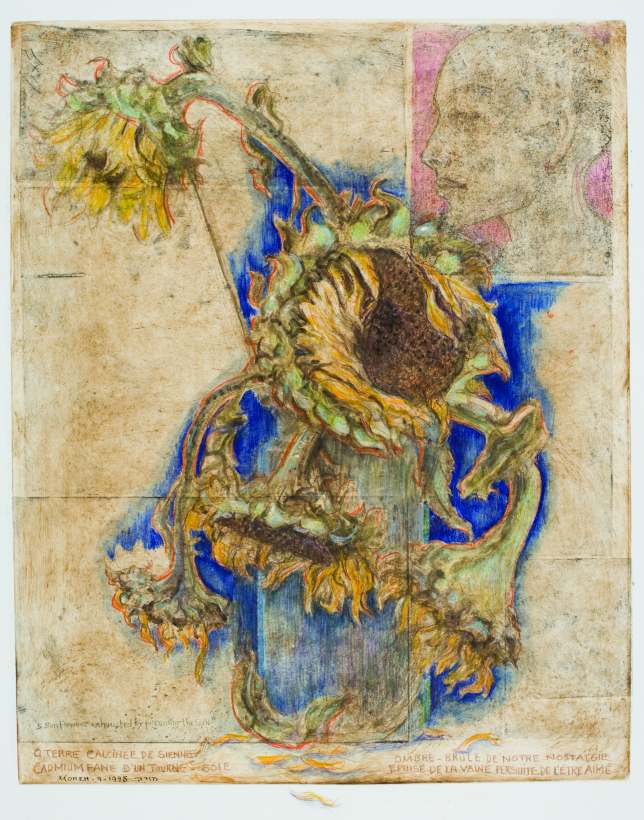
Mordecai Moreh
Edouard Roditi, More Dialogues on Art
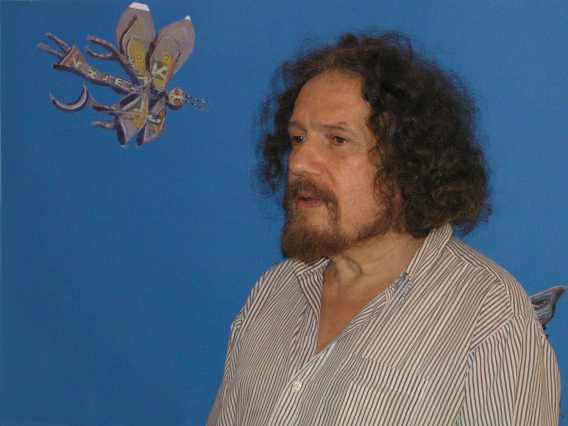 |
| Mordechai MOREH |
An Iraqi-born Israeli, Mordecai Moreh has been living in Paris for some years, though he returns to Israel for several months every year with his wife and children, in the course of which he generally exhibits there with great success. He feels, however, that Paris offers an artist more privacy as well as a more varied and stimulating cultural environment, a greater choice of contacts with critics, galleries and other artists, and an easier access to the art markets of other nations, whether in Europe or elsewhere. As a studio, in Paris he uses a small fourth-floor walk-up apartment in a modest nineteenth-century building on a street off the Place Clichy on the border of Montmartre overlooking at the time of our conversation part of the huge Montmartre cemetery beyond an enormous building site where a gigantic new hotel was being constructed. The Gaumont Palace stood there until recently, a masterpiece of art deco architecture of the twenties, in fact, a Paris equivalent of an American Balaban and Katz dream temple, now a victim of the vandalism of recent real estate development.
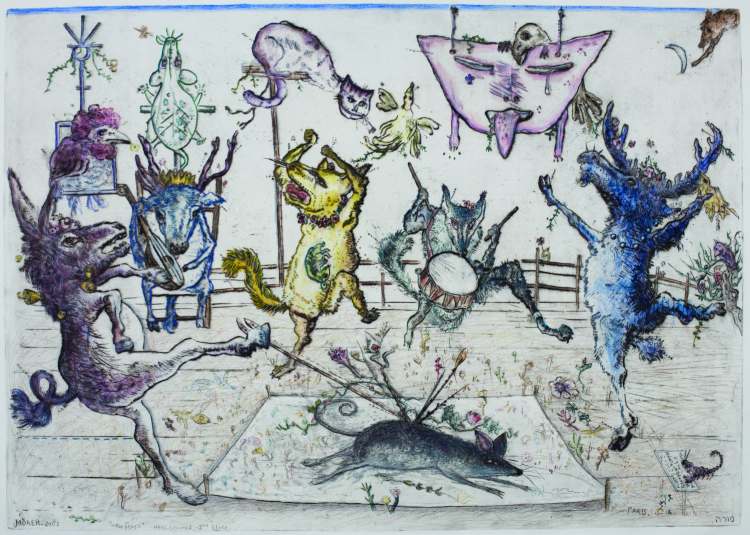
To this studio, Moreh commutes daily from another apartment where he lives with his wife and three children, the youngest of whom, early in 1981, was three months old. In addition to an extensive selection of his own older and more recent paintings and etchings, Moreh has accumulated here, around his easel, a surprising variety of curious that he collects with the taste and knowledge of a very eclectic connoisseur. They include classical Japanese and Chinese paintings, rare Oriental carpets and Uzbek embroideries from Bokhara, European renaissance bronzes, an extensive collection of Tantric sculptures and paintings from Indra, Nepal and Tibet, oddly carved neo-gothic nineteenth-century chairs that look as if they might have been salvaged from the props of a Wagnerian opera-in fact almost any kind of art that can puzzle, amuse or enchant a truly inquisitive mind.
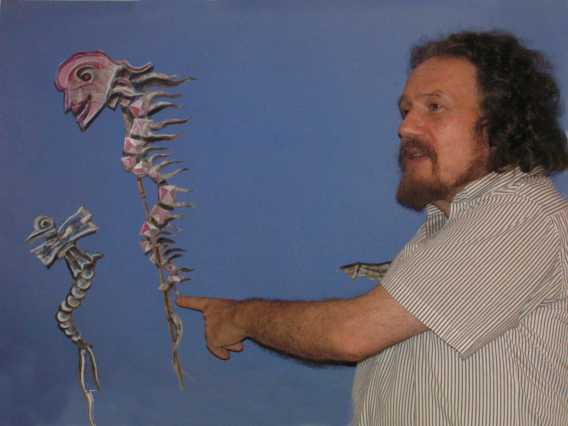
Moreh's physical appearance, in the midst of this crowd of weird animals, human figures and supernatural beings that seem to stare at him in a circle like watchful familiar spirits while he works in the limited space reserved for his easel, is that of a kind of cabbalist or guru. His tousled head of long black hair spreads around his face like a dark halo while a smile hovers on his lips whenever he speaks. In a way, he thus reminded me of the appearance of the Maharishi Mahesh Yogi, whom I had met some years earlier in a Bombay radio studio in the course of a daily "People in Town" broadcast of interviews sponsored by The Times of India.
I originally became interested in Moreh's work some years ago in Paris, when Israeli statesmen and the Jewish press throughout the world (at the time of the disturbances caused in Israel by the Moroccan-Jewish Black Panther movement in protest against slum conditions and lack of educational opportunities for young ]ews from Arab countries) tended all too frequently to make disparaging remarks about the presumably meager contribution to Israeli cultural life of the massive influx of Jewish immigrants from the Islamic world. This Yiddishist ethnocentric prejudice riled me personally as a Sefardic Jew who still maintains close ties with family and friends in Istanbul, several of whom play an important part in the economic, literary or scientific life of Turkey. In my regular monthly reviews of current art shows in L'Arche, the official periodical of the Federation of French Jewish Communities, I then began to make a point of publicizing whenever possible the work of promising younger artists of Oriental-Jewish origin, among whom Mordecai Moreh and Hadad, both of Baghdadian extraction, and Eliahu Abrahami, an Israeli of Iranian origin whose native language is still Aramaic, soon became my favorites. With their help, I gradually discovered too that the contribution of Oriental ]ews to Israel's artistic, literary and scientific life is already very considerable, but tends to be either ignored or patronized as something quite exceptional by the Israeli establishment.
Some years later, when Black Sparrow Press in Santa Barbara agreed to publish Thrice Chosen, my collected poems on Jewish themes, and asked me to select an artist to design the cover of the book, I submitted my manuscript to Moreh, who agreed to contribute an etching. The notes for the following dialogue were taken in the course of one of our meetings in his studio, when he asked me to choose the most appropriate design among several sketches that he was submitting to me.
Although not yet very widely known as a painter, Moreh has already exhibited extensively in France, Israel and West Germany, especially as an engraver, and is well represented in the graphics collections of a number of leading museums. As eclectic in his readings as in his own art collections, he is particularly well versed in classical and modern Hebrew and Arabic literatures, but is also widely read in English, French and Italian literatures and has even written and published some poetry of his own in French. One of his brothers, Shmuel Moreh, is one of Israel's most distinguished contemporary Arabic poets; although banned, as a Jew, from publication in most of the leading Arabic literary journals, which are published mainly in Iraq, Syria, Lebanon or Egypt, he is included in English translation in the Avon Books paperback Voices Within the Ark, an anthology of twentieth-century Jewish poets, and professes Arabic literature at Hebrew University in Jerusalem. Another brother, Raymond Moreh, is a research scientist in nuclear physics in Israel, while a third, ]acob Moreh, the oldest of the three brothers, teaches economics at Queens University in Belfast. This one Oriental-Jewish family's contribution to Israeli cultural life is thus as rich and varied as that of any family of European or American origin.
E.R.: I understand that you were born in Baghdad and spent your childhood there.
Moreh: Yes, I emigrated to Israel when I was thirteen, in 1951. My basic schooling was in Arabic, English and Hebrew, in a Jewish school in Baghdad.
E.R.: We in the Western world know very little about the socio-economic and cultural backgroud of the ]ews of Iraq before most of them suddenly emigrated in 1951 to Israel or elsewhere. Do you mind my asking you to describe briefly your own family background?
Moreh: To begin with, Jewish communities have existed in Mesopotamia, that is to say on the territory of modern Iraq, for more than twenty-five hundred years, in fact at least since the Biblical first exile in Babylonia. The Talmud was compiled there later in its second edition, so that we had a very ancient and venerable tradition of Jewish scholarship and poetry of our own, which was maintained well into the present century, even after we began to be westernized in some of our ways and habits towards the end of the nineteenth century. My father was already an accountant in an English export-import firm in Baghdad. Without belonging to the minority of very wealthy Baghdadian Jewish families, we lived comfortably as members of a middle class that was to some extent westernized and included a considerable number of professional men, many of whom had studied in foreign universities. Among the younger men of my generation, several of us were passionately interested in contemporary Arabic literature, and a few Iraqi Jews, as a matter of fact, played quite an important part in the revival of Arabic literature in Iraq until most of them emigrated to Israel, so that many of the leading jewish writers who now write in Arabic in Israel, such as my own brother Shmuel, are of Iraqi origin. Like all other middle-class Iraqui families, whether jewish, Christian, or Mohammedan, we lacked, however, an understanding or an appreciation of the visual arts, as is generally the case in the Islamic world and especially in all Arab nations. We had, for instance, hardly any paintings or reproductions of paintings in our homes, and our appreciation of objects of art tended to be restricted to beautiful and rare carpets or textiles or to the work of silversmiths. Although I began to draw and paint even before learning to read or write, my parents never encouraged me in this activity except as a mere form of play. Nor was this because of any specifically jewish prejudice, like that of Soutine's father, for instance, who was shocked to see his young son depicting human figures and thereby flouting the orthodox interpretation of the Biblical veto on graven images. On the contrary, my parents were quite tolerant in this respect, but it never occurred to them that I might become an artist and even earn a good living by practicing what they believed to be a childish hobby. Most Mohammedan countries in those days still had no tradition of professional art in the western sense, except in the fields of calligraphy and of the miniaturist who could illustrate the classics of Arabic or Persian poetry or prose. At best, the calligrapher and the miniaturist enjoyed the status of a respected craftsman and depended on the patronage of rulers or a few very wealthy men. By now, however, things have changed and the modern art movement has penetrated a number of Islamic countries. Iraq, among others, officially encourages its native Arab painters and sculptors.
E.R.: I happen to know that Iraq even encourages Arab artists from other countries; in 1979, my friend Marwan, a Syrian painter who lives in West Berlin, was invited to exhibit in Baghdad, where his show was a great success. But your own formal artistic education, if I understand correctly, began only after your arrival in Israel.
Moreh: Yes, I actually began to study art only after graduating from secondary school in Israel, though I had never stopped painting and drawing from my own imagination ever since the age of four. On entering art school, I already had a considerable body of work behind me. In the Bezalel Fine Arts Academy in jerusalem, I began to study drawing, painting, woodcut and etching in a more formal way, and four years later, in,1960, I had already acquired enough proficiency to be granted a four-year scholarship by the Italian government to study in Florence. But I was soon disappointed by the teaching in the Florence Academy,and two years later, in 1962, I moved to Paris. Except for my annual trips to Israel and an occasional trip to neighboring European countries, I've been living in Paris eighteen years.
E.R.: I would like to come back to your four years in the Bezalel Academy. I presume that art students of Oriental-]ewish origin, such as yourself, were in a minority there, and that the teaching staff was exclusively European.
Moreh: Yes, there were very few of us among the students, and most of our teachers were German or followers of the German expressionist movement, some of them even former pupils of famous expressionist masters. I was very much an alien there as I had always tended toward a more visionary concept of art that would be closer to that of the surrealist school, though with a love for fine and minute detail and a very elaborate technique. What they taught me at the Bezalel Academy very soon disappointed me, but there was everywhere, in nearly all art schools, a great deal of confusion when abstract art was triumphant. For instance, I found that nowhere would they teach me such elementary matters as the techniques of sizing a canvas or how to use brushes and pigments most effectively. In those years, too, the various trends in painting were changing so rapidly, like fashions in women's garments, and I felt no need to follow any of these new trends.
E.R.: What choices did you finally make?
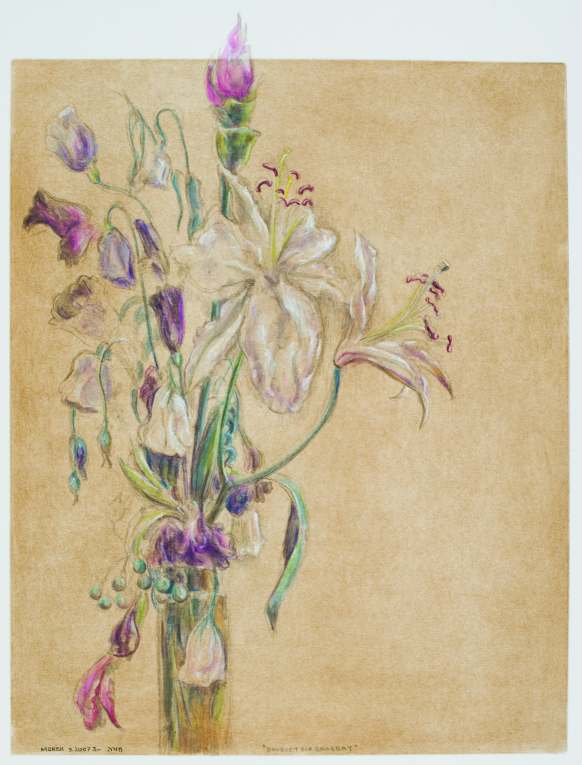
Moreh: Actually, I made no choice of movement or style, but remained more concerned with the task of acquiring technical skills that would allow me later to communicate more convincingly whatever I might feel compelled to depict. Whether in terms of images in the visual arts, of plots or ideas in literature, or of themes in music, I believe the artist should be primarily inspired by his own inner world and personal experience rather than by trends or fashions in art or by the work of other artists. Of course, he may emulate others when he seeks ways of communicating his own personal inspiration, but if his self-expression is destined to become credible communication, he must know how to develop and clothe it convincingly by means of his craft and skills. These are his instruments, and my own instrument consists in techniques that help me produce clear and concrete visual images. Were I a poet or composer, I'm sure I would explain my critical approach to my work in much the same terms.
E.R: So these skills, in your opinion, are essentially a kind of rhetoric, in the classical sense of an art of persuasion and of convincing ....
Moreh: I suppose so, but certainly not a rhetoric of sheer display of eloquence. I'm no believer in "art for art's sake", but remain convinced that art must have a message so as to express what I would call the religious sense of man.
E.R.: Do you mean his sense of wonder and reverence?
Moreh: Yes, even if the subject matter or message contained in his art isn't necessarily of a strictly religious nature. In this respect, I feel that art should always display a close, though not necessarily overt, relationship with religion and magic. Even in as sophisticated a society as the one in which we now live, the artist indeed remains a kind of priest, magician or shaman.
E.R.: This belief would imply that art in an age of agnosticism tends even to become a kind of substitute for religion. Some Italian humanists already began to suggest this in the sixteenth century, when Vasari wrote his Lives of Famous Artists along the lines of the mediaeval Christian Lives of the Saints and, of course, Plutarch's Lives of Great Men in classical antiquity. The Italian poet Torquato Tasso went even further when he wrote his Discorsi, which are a kind of poetics of the chivalrous romance. There he explains that the poet, through the magic of his art, emulates the creative activity of God and creates, if only by illusion, a world of his own. At the same time, in his own poetry Tasso also describes in great detail the activities of magicians whose art remains one of sheer illusion, always vanishing as suddenly and mysteriously as it had been created. Tasso's whole poetics thus remains, in a way, very ambiguous, since it suggests, though perhaps unconsciously, that art in the final analysis may well be as perishable an illusion as the activity of a magician.
Moreh: I'm afraid that a great deal of what now passes muster as art may well be mere illusion. The final test of art, I suppose, must be its spiritual, esthetic and emotional impact on the individual, in fact, its ultimate significance as a message from the artist's inner world. The artist himself, in the moment of creating, need not always be conscious of the ultimate meaning of this message, which springs from the depths of his own consciousness. I myself have often discovered the real meaning of some of my works only along while after producing them.
E.R.: You seem to be suggesting that this message, in order to avoid being solipsistic and to be meaningful to both the artist and others, should spring from some kind of collective memory or subconscious so that it would then correspond to what Jungian theorists would call an "archetype".
Moreh: I would go even further and say that an art that has no such message to convey thereby reveals its own poverty and emptiness. I believe that a real artist always feels an urgent need to express something, though he often discovers the real nature of what he is expressing only after he has expressed it. I'm not proposing that art should always be solemn and portentously profound. Comedy and farce are as valid forms of art as melodrama and tragedy, and an artist may well feel an urgent need to express himself playfully with wit or humor as a satirist or cartoonist. In fact, I distrust people, especially artists, who always take themselves too seriously.
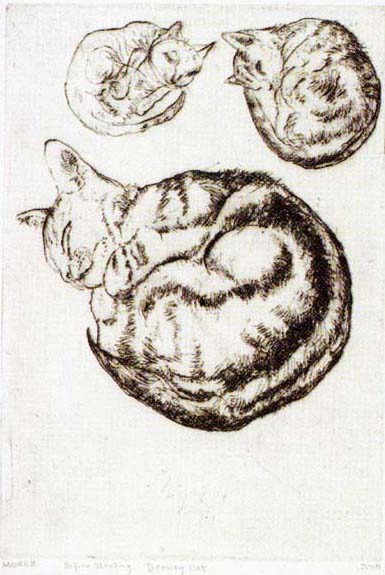
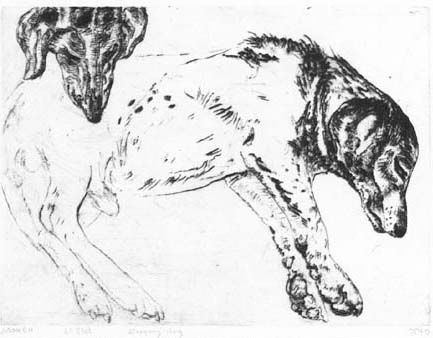
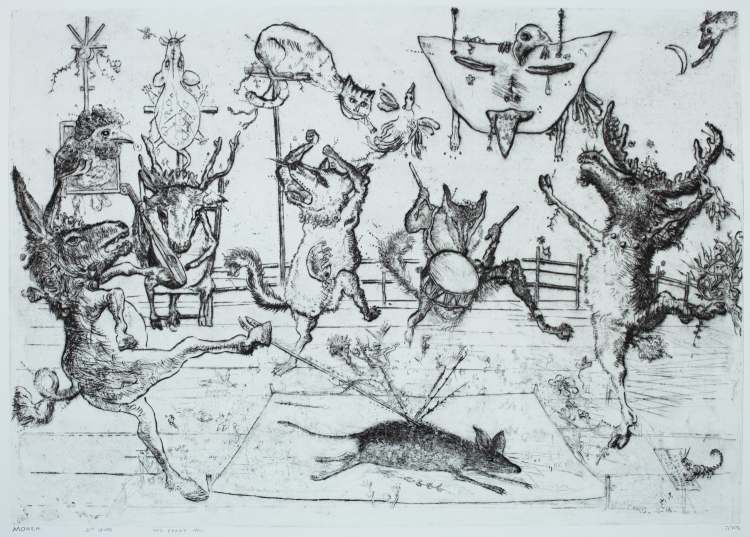
E.R.: Let's now return to a more specific discussion of some of the characteristics of your own art. Could you explain to me, for instance, why you so often choose to depict animals rather than human beings?
Moreh: Depicting the image of man today too often confines one within strict limitations of time, place or race. His color, clothes, haircut and all the rest betray his origin, his country and his era.
E.R.: This sounds a bit like the aesthetics of neo-classicism, which tended to depict men and women of every race, nation and age in more or less the same costumes of an imaginary Greco-Roman antiquity.
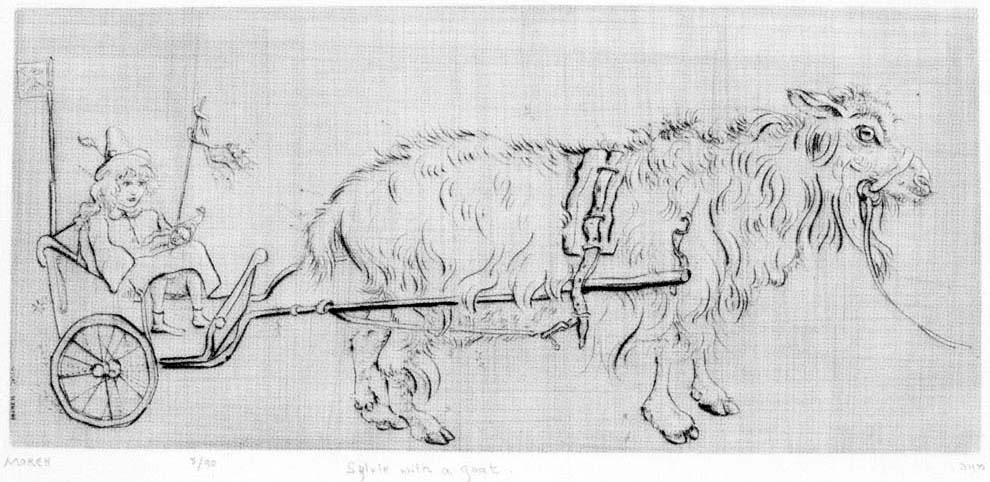
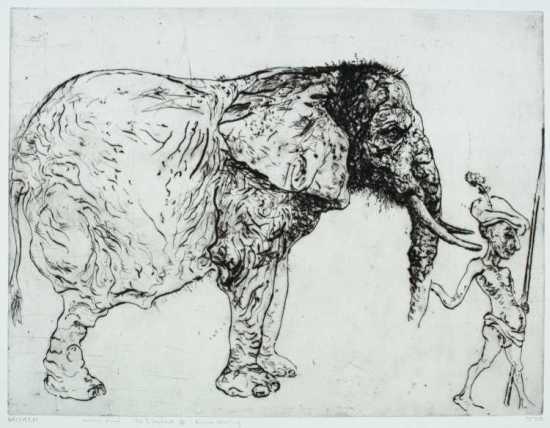
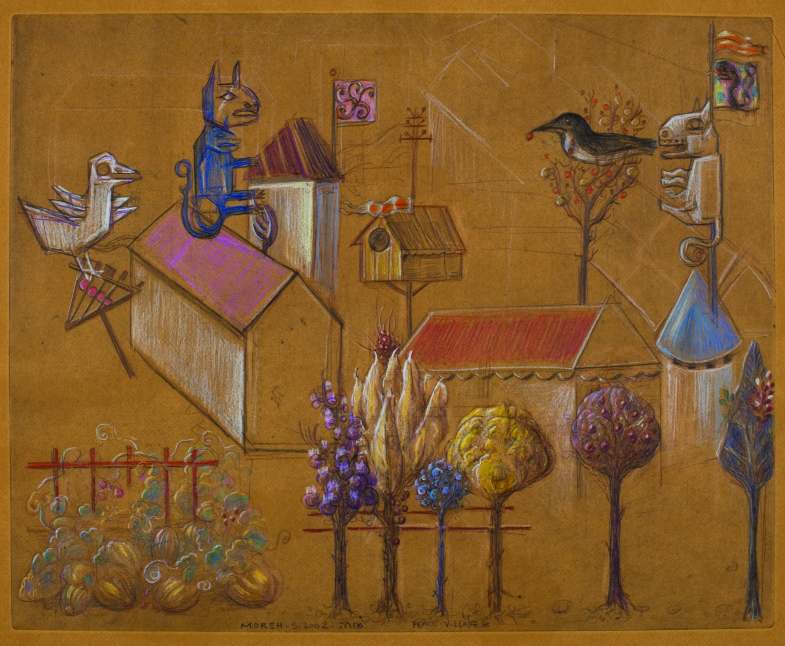
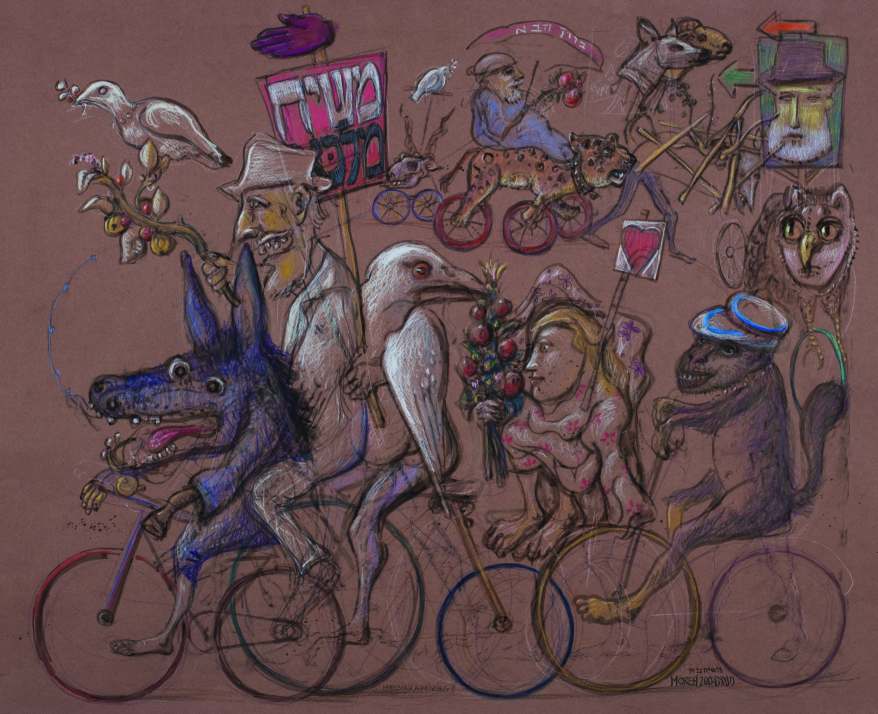
Moreh: Perhaps, but I find among animals a far greater variety of possibilities for an expression that remains timeless and universal, in fact a far more diversified message. Take for instance an image of a crucified man: most people who see it will immediately identify it as representing Jesus. But if I depict a crucified bird or a crucified deer, I feel that I'm suggesting a far more generalized idea of suffering, victimization or self-abnegation, whether of man, of animal or of nature itself. Such an image can suggest physical or spiritual suffering, and can, of course, also remind one of Jesus.
E.R.: True. I recently saw in a Paris auction room a fine nineteenth-century etching by Felix Bracquemond, Le Haut d'un Battant de Porte, depicting crucified birds on a barn door, which used to be a fairly common sight in the French countryside. Instead of reminding me, however, of the crucifixion of Jesus, this weird image called up in my mind a whole train of thoughts about man's sadism, which can express itself by arbitrarily arresting the flow or flight of living nature in a macabre parody, in this case the victimized bird's flight. But do you feel that your art, when you depict animals, has anything in common with the imaginary world of Aesop and traditional fabulists?
Moreh: Not really, because fabulists seek to illustrate human situations and behavior satirically in their zoomorphic fables, which attribute human virtues or vices to animals, birds or insects. I seek, on the contrary, to reverse this process when I depict animals, in fact to demonstrate that animals, birds or insects can suffer as much as man if we deprive them of their freedom or humiliate or torture them.
E.R.: In Bracquemond's etching of a crucified owl, the very posture of its wings outspread in death on a barn door suggested to me a macabre parody of flying, in fact of embracing the whole world in the freedom of life. But this freedom had become mockery here through the martyrdom of crucifixion and the destruction of identity in death. As a meaningful symbol, the crucified owl could thus suggest to my mind both a beginning and an end, the whole mystery of creation and destruction. Now you're also reminding me with your theory of those basic mysteries of Judaism as a religion and of cabbalah, I mean the three mysteries that must be accepted by an act of faith because they transcend reason: the mystery of the Beginning in Genesis, of the Merkabah or Throne of the Lord in the vision of the Prophet Ezekiel, and the mystery of the Revelation of the Law to the Chosen People and of the promise of the coming of the Messiah, meaning the end of the world as we experience it. When I came to see you some time ago, you already told me that you are interested in alchemy and cabbalah. How and when did you first become aware of their significance in your life and your art?
Moreh: Twelve years ago, while I was looking at some of my older drawings and paintings that l had kept since my adolescence, I became aware of the fact that they were full of images that have symbolic meanings. Gradually, I discovered that such symbols continue to populate my works, in fact ever more extensively. But these readings do not now suggest to me the symbolic images that continue to appear in my work. On the contrary, they only help me to understand the meanings of these symbols and to confirm my belief that the world I depict is not at all arbitrary or autistic, but corresponds to ideas that have a less personal and more general significance in alchemy or cabbalah and are therefore somehow connected with what I have already called the basically religious nature of man.
E.R.: Could you now quote an example of this kind of symbol and of how it first occurred to your mind and only later became fully significant, I mean retrospectively when you happened to contemplate one of your much earlier works after these readings of alchemy and cabbalah?
Moreh: When I was fourteen, again and again I had visions or inner images of a gigantic figure dancing and, at the same time, trampling another being beneath its feet. Twenty years later, I recognized this figure as Mahakala, the devouring power of time, as it is depicted in traditional Tibetan tankas, and I was only then able to understand what the meaning of this image had always been, owever unconsciously, in my mind and in some of my earlier drawings.
E.R.: Are you suggesting thereby that certain images, irrespective of time and place, race and culture, must always have the same meanings as archetypes, so to speak, in the terminology of Jung?
MOREH: I suppose so, but only those images and symbols that designate the same universally human experiences of love, life, birth or death, our human relationship to the whole universe and our human quest for the absolute. At the same time, however, I became aware of creation as an infinite and eternal process in nature, so that every living creature is unique in its own way. I thus find real creativity, even my own when it is real, as varied as nature in its forms, so that I can never repeat myself since each real creation is always unique. As soon as I see that I'm repeating myself, I know
that I'm no longer being truly creative.
ER.: How can you know that you're already repeating yourself?
Moreh: My touchstone for testing real creativity and distinguishing it from repetitiousness is, of course, a feeling of surprise and wonder. If one of my images can surprise even me, though only as a novel variant on a theme that I've already handled elsewhere, I know that I'm still being creative and wouldn't have been able to create this new image only by conscious effort and reasoning. In order to be creative, I must be in a state that transcends my faculties of reasoning and intelligence so that I actually surpass my normal self. But real creativity all too often appears to escape us. There is something in it that cannot be grasped at will, and it can be achieved, at best, in moments when one forgets one's awareness of self. An image that imposes itself on the artist's mind, clamoring for material existence as an object, sometimes overrides the artist's reason and momentarily blots out his awareness of self.
E.R.: Could you cite me an example of such an image that imposed itself on your mind and your reason, clamoring for
existence, as you say, in the form of an object?
Moreh: Well, let's say that I've set out to paint only a tree. Suddenly, while I'm painting it and in spite of myself, I begin to visualize an egg in the trunk of the tree that I'm depicting, though it escapes my reason why an egg should happen to be there. Only later, once I've completed the painting, do I understand that this egg is an essential part of the composition, though I may not yet be able to explain why. Again and again, I discover that I've painted something that I would never have suspected myself of even being able to imagine, and I sincerely believe that what is best in a work of art is what escapes the artist's immediate awareness and understanding.
E.R.: All that you've just said reminds me both of Plato's theory about ideals that, so to speak, pre-exist their materialization as objects and also some more modern philosophical or psychological theories of intentions or mental conceptions according to which an dea or mental image becomes "reified" when it is transformed into an action or an object. A chair like the nice neo-gothic one on which I'm now seated would thus be, in Platonic terms, a material representation of the ideal of such a chair or else, in more modern phenomenological terms, the "reification" of the idea or concept of such a chair. Your painting of an egg embedded in a tree trunk would likewise be the "reification" of the image or symbol that had mysteriously imposed itself on your mind.
Moreh: Yes, ideals need to be expressed, and mental images can be said to clamor to be created as objects. I'm never really conscious of having a message to communicate, but I've gradually learned to understand that as an artist I express things that need to be expressed. If I feel a need for self-expression, I'm not yet fully aware of what its meaning or message will be. In a way, I'm then like a pregnant woman who knows that she'll bear a child, but cannot yet
say whether it will be a boy or a girl, and even less what it will grow up to be.
By now, it was time for me to leave Moreh's studio and go home to cook dinner for a couple of guests. Later, as I drafted my notes of our conversation in the form of the present dialogue, I realized how felicitous my choice of Moreh for the present book had been. His remarks about art are far more original and profound than anything that Chagall, for instance, had uttered to me when I interviewed him, many years ago, for my first collection of such Dialogues on Art. Moreh reveals thereby that immigrant Jews of Oriental origin, in spite of all the disparaging remarks that have been made in Israel and elsewhere about their Arabic cultural background, indeed can contribute a great deal to the cultural life of their new home and to the much richer and more varied artistic life of Paris. True, Chagall had been very informative in terms of personal biography and contemporary art-history, and I'm told my talks with him are still of some factual interest. But Mordecai Moreh proved in our conversation to be both a very skilled and original artist and a profound poet and philosopher of art.
A few weeks later, I went to meet Moreh at the Atelier Leblanc, where he used the presses to print the etchings that I had now to fetch and mail to Black Sparrow Press in California. Situated beyond the back yard of a building on the Rue Saint lacques (along which medieval pilgrims, having been blessed at the foot of the gothic tower that bears the same name, used to set out on foot or horseback from Paris, like Chaucer's pilgrims to Canterbury, on their much longer trek to Saint John of Compostella in distant Spain) this venerable workshop, with its hundred-year-old handpresses still in perfect working condition, overlooks a charming little garden that suggests a quiet provincial town rather than the heart of a busy modern metropolis. It was here that Corot, Pissaro, Manet and many other great printmakers of the past came to use the same presses as Moreh. Together with the two friendly French craftsmen who operate them very skilfully, Moreh was merrily chatting, much as Corot, Pissaro or Manet might have done over a hundred years ago, and looking, with his halo of tousled hair, almost like a Faustian sorcerer with his assistants or familar spirits in his mysterious den.
 |
| |